
XR/VR/AR
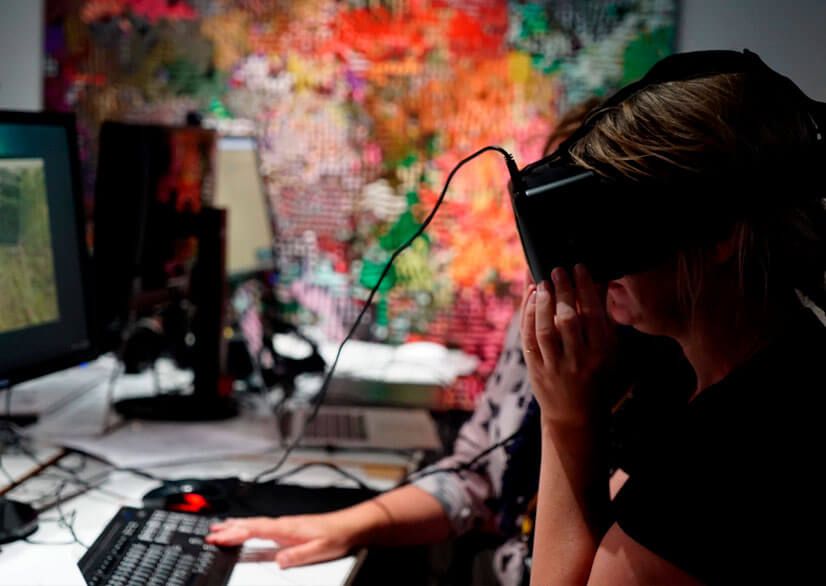
In Aalto Marsio at Otakaari 2A, the 80m2 XR Studio is equipped with five editing units all with dual screens, powerful graphics cards and HTC Vive and Oculus Rift headsets, as well as a large green screen background. Digital Studio in the same building is equipped with Varjo XR-3 headset and base stations, and Captury mocap system. The Takeout services include AR glasses (Microsoft HoloLens), Insta360 cameras, and 55” & 65” touchscreens.
Visualization Studio in Marsio features the Igloo Vision 6-m cylinder for shared VR, and a power workstation for 360 live stitching.
In Tampere University there is a wide range of VR and XR headsets for different purposes. As of writing this (Meta Quest 3, Varjo XR 2, 3, 4 (all variants) and Aero plus a number of laboratories equipped with computers, base stations and other facilities for their use. In the Multimodal Driving laboratory has a Motion Systems PL-6TL-350 R2 motion platform for vehicle simulations. It is surrounded by whitescreen where the environment can be projected and removable greenscreen displaying virtual surroundings with Varjo XR4 masking functions and similar systems. On the platform one can install a mock-up of any cockpit or control station up to about 250kg of weight (excluding the operator).
Uniarts has a 48m2 Digital Studio equipped for VR in the Mylly building at Sörnäinen campus. The headsets are Varjo XR-3 and Valve Index.
The ULapland XR lab includes Oculus Quest 2 and Varjo XR-3 headsets and an 8-camera Optitrack system. Additionally, the lab is equipped with pupil core eye tracking glasses. A driving cockpit with a Logitech trueforce wheel and a Probot robot dog are also available in the lab.
The virtual production studio at the University of Lapland has a 7.5-meter by 3-meter LED screen at its core, constructed with the industry standard ROE Black PearlV2 2.8 pp LED panels. The studio’s lighting setup includes pixel-mappable lights, such as Vortex4, Vortex8 and Amaran 22c. Camera tracking is via the HTC Vive Mars system, ensuring precise alignment between the physical and virtual elements.
Turku University of Applied Sciences has facilities and expertise on XR, VR and AR experimentation, development and research. The environment supports immersive learning, simulation and training solutions, digital twins, user experience studies, and audiovisual production. The Showroom facility features a 12 × 55-inch display videowall with a Genelec 7.2 audio system. Equipment includes a wide range of VR, AR and XR head-mounted displays (HMDs) from Varjo, Meta, Pico and Valve, including both current-generation and legacy devices. This enables compatibility testing, comparative studies and development across multiple hardware platforms. Additional equipment includes tracking systems, 360° cameras and other technologies that support immersive and interactive XR experiences.